Tuesday, 19 May 2009
The World's Greatest Act of Propulsion
“The World's Greatest Act Of Propulsion, Is A Pat On The Back.”

Sunday, 3 May 2009
Uzuri Wa Mkakasi
Uzuri Wa Mkakasi, Ndani Kipande Cha Mti.
An ornate casket may be beautiful, but underneath it is only a piece of wood.
Beauty is only skin-deep
An ornate casket may be beautiful, but underneath it is only a piece of wood.
Beauty is only skin-deep
Saturday, 2 May 2009
Home Brews~Are they Safe
This week Africa Live is discussing whether home-brewed alcohol has a place in modern Africa.
Every country in Africa has a home brew:
Ogogoro in Nigeria.
Umkomboti in South Africa.
Nsafufuo in Ghana.
Kurova Guva, Chihwani Dheyizi & Tototo in Zimbabwe.
Chibuku, Shake Shake, Katata & Lutuku in Zambia.
Kong in Sudan.
Katikala in Ethiopia.
Chang'aa, Tapu Tapu, Mbege, Chibuku & Muratina in East African Coast, Kenya, Tanzania & Zanzibar.
Did you know that Scotch whisky was like Chang'aa, illegal? Brewers of whisky in Scotland did running battles with the police just like Chang'aa brewers in Kenya but eventually sense and sensibility prevailed. Legalise Chang'aa like Konyagi and Waragi in neighbouring Tanzania and Uganda, respectively.
Local brews can provide much-needed money for poor families. They are also used during traditional ceremonies such as pouring libation, weddings and funerals.
But if not brewed properly, they can be dangerous and each year hundreds of people die after drinking these spirits.
In my Opinion, It is important to understand what we are debating about.
Alcohol~It is known to be harmful, if drunk excessively.
Local Brew~Is also a Alcohol, just as good and as harmful as any other.
Important~The point here is to ensure that the untensils used are clean & sterilised, whilst making Home Brew.
It is also important to use the correct ingrediants and not take short cuts and use other chemicals and change it from the original recipes that have been handed down fom generations to generations.
It is human Greed that leads us to cheat others of the real produce.
Reduce your consumption. Keep it away from our Children.
Western Alcohol and Brews are just the same and as any other Home brew.... Period.
What I cannot accept is, When "So Called Westerners" try and justify ONLY thier brew's are legal and are less harmful then any other brews around.
For those who Drink ~ Enjoy your Drink.... Don't let the Drink enjoy you!!!.
~K Attalia, Mombasa, Kenya (Now UK)
What is your experience with home brew? Do you think it has a place in modern Africa? Or does it encourage alcoholism and laziness? Send us your comments and experiences.
Should we drink home brews? ~ Do you make local brews?
Hence I am of the opinion that it does more harm than good to the society, as these drinks cause more health problem to these folks. In Nigeria among the lower classes, local brew has become an integral part of their every day diet. As early as 07:00 in the morning you find people at the bus park taking their usual "Shot" as they call it. The most painful part of it all is that the bus drivers also "mark register" with the sellers.
~Owolabi Kayode, Nigeria
I don't think it is fair to criticise home made brews because if it isn't abused it is just like any other commercial alcohol. What's the difference between popular Irish whisky, traditional Japanese Sake with any other brew? Traditional brew is a cornerstone to our cultural society. In Zimbabwe we have traditional ceremonies such as "Kurova Guva" and you can never do that without traditional "Ndari" brew prepared by old women. Traditional brews need to be integrated into modern society by ensuring proper hygiene and discouraging abuse. Traditional brews are a cornerstone of communities in Zimbabwe.
~Elias Matinde, Japan
I believe the main reasons why people get involved with home-brewed alcohol is poverty and the speed at which this brew can make you drunk. You only need less than half a pint and you are in a different world. This is compared to the European whisky and beers that are slow in response. Trying to control the home brewing will not solve any related problems, however, it will make it worse and the brew will be in high demand.
We need to educate people and make them understand the consequences of drinking any home-brewed alcohol. Also jobs must be provided to keep them busy as anyone working for seven or more hours a day will have difficulties balancing their working and drinking life.
~Jean-Paul Muana, DR Congo/UK
It's been over a decade since I stopped drinking African home brews. I simply think that all home made brews pose health risks. Try inspecting it from start to finish and then tell me if you won't quit drinking it.
~Daniel Deng, Dallas and Denver, USA
I don't think home brew production should be stopped altogether but distinctions need to be made. Drinking "Chibuku", "Shake Shake" and various types of grain beers is about as harmful as drinking any other bottled alcoholic beverage, it's all in the moderation.
But drinking home brewed spirits like "Katata" & "Lutuku" is dangerous and highly addictive. These drinks carry an alcohol percentage that's high enough to darken a piece of meat. This is dangerous. Some way of limiting the alcohol content in these spirits should be agreed on and made enforceable.
~Chibale, Zambia
Yes we should drink home brews because such beverages are a part of our culture. With these we feel we are contributing to sustaining our culture. This is however not to say that care should not be taken in the preparation of such brews to avoid unnecessary death.
~Emmanuel S Koroma, Sierra Leone
Well, as a child whose father is an orphan and who never went to school; it was the local brew called Chang'aa that gave me a chance to learn how to write my name. My mother who never drinks made the brew and bought me school uniforms, books and pencils. That was in western Kenya after independence when the schools were free.
Yes, I think it has a place in modern Africa because there is no difference between Whisky, Wine, Beer and many other drinks that the Europeans stock in their department stores and the African brews.
~Victoria Dyhr, Helmsange, Luxembourg
There should no place for local brews like Ogogoro, Chang'aa etc. in Africa. Apart from the fact that they promote laziness as experience shows in both Nigeria and Kenya, it is hazardous to people's health. In fact it is the Highway Code to the grave. It is true that income from local brew supports some poor families but at the same time, those spots are breeding place for criminals.
~Aleke Patrick, Nigerian in Brazil
Recently Uganda topped the list as one of the countries that has the most citizens drunk, almost all the time. I think this home brew is pulling us backwards - how will we develop with people whose minds are always clogged up with alcohol?
~Lajul Faith, Uganda
Local brew is not just economically feasible to make but it gives women in African society a chance to earn their livelihood. It also gives them pride because they are following a long tradition. It becomes a problem when Western Chemistry meets an uninformed mind.
~M Wuoi, Kenya
Whether home brewed or factory brewed, alcohol is bad and people should be discouraged from drinking alcohol! The Bible says: "A country whose leader dines and wines till late is in trouble." In my country Uganda, all the problems were a result of the drunkard president, Milton Obote! Even Id Amin used to drink Whisky secretly! We are lucky now that Museveni only drinks Pepsi Cola!
~Balaam Bamwenda, Kampala, Uganda
Home brews are being abused in Africa. They are an offshoot of the traditional African beer, which was part of our culture. Then, the beer was prepared and consumed under strict cultural rules and conditions that made sure that it did not disrupt the societal norms and harmony. There were rules as to when it should be drunk and by whom. Normally only adult married men were allowed to drink. Today all this is abused under commercialisation, with even children having access to the brews. The brews are a source of death to the body and societal norms. They are prepared under very poor conditions! Away with these killer brews!
~Peter Ndichu Karanja, Cape Town, South Africa
Just to add another country to your list. Ethiopia. They have a homemade alcohol; it is called "Katikala". It is a very strong cultural beverage and has almost 100% alcohol per volume. Sometimes they drink this beverage while eating raw meat. I have never done it but I see many people using it especially in the rural areas. The other advantage to consuming this product is that it is affordable.
~Leul, US
I think drinking is part of man and cannot be separated from our day to day activities. This brewing provides jobs to about 40% of the farming populace. Hence I think what we as Africans have to do is to research and improve the quality of these drinks and educate our folks on the quantities to be consumed to avoid health related problems, which could affect the continent's productivity and dive into our meagre donor funds.
~Okine, Richmond, Ghana
Homemade brews are part of our heritage as Africans. Before the days of colonisation a lot of our socialising and activities were in one way or another connected to our brews. So let's just improve on the quality and set standards so that we can maintain our identity and celebrate Africa with Africa's own. Alcohol can cause harm to us irrespective of what type it is so if you must drink why not let it be something local.
~Flora Aduk, Uganda
No-one can stop local brews in Africa, simply because it is a major source of income for the rural folks. The local alcohol can be used for other medicinal purposes. But the only bad aspect of it is, it can be dangerous when intake is too much. One needs to be careful when dealing with it.
~Reagan Fianko, Kumasi, Ghana
Love it or hate it, home brews are just like commercially produced alcohol. Difference is though that they are not lab tested for percentages, potency, shelf life etc. Some western country homes also make their own concoctions out of various fermented products. If hygienic conditions and nutritional values can be maintained it is alright. Alcohol is alcohol and will cause some harm if drunk in real excess! A shot of fresh made "Munkoyo" once in while brings a smile to my face.
~Gabriel, Lusaka, Zambia
I think home brew encourages alcoholism and laziness. And because people get so drunk they then have sex, which leads to HIV. The governments of different countries should not encourage this foolish and stupid business. See for yourself what HIV has done in our society. 80 percent of HIV infected persons get it from sex. and what causes this? For me it's alcohol. I encourage people to stop drinking alcohol and if they do they will be happy and see that they have a good and healthy life. Even though it's difficult, turn to the almighty God for help.
~Awanto Augustine Anye, Bamenda, Cameroon
Home made beer comes in two categories just like the factory brewed alcohol. There is a brew that is generally good to drink whose percentage is within the permissible range of which it is the one that we are discussing here. Then there is pure spirit dubbed "Tototo" in my country Zimbabwe. This type of home brew can burn your liver and knock you out within minutes. It has claimed a number of lives in and around Zimbabwe and the Mozambique area. People love this beer because it is cheap and is a food supplement for them. However because of poor yields not so many people are brewing the beer anymore - people are more worried about getting a decent meal.
~Bingepinge Chengetayi, Canada
A big yes because communities must patronize their locally produced products. Africa in particular must urgently consume African made products. However, there is the need to improve the quality of our products to avoid poisoning ourselves, as has been the case in some areas regarding local drinks.
~Francis Owusu-Ansah, Ghana
I believe our home brews are as good if not better than the factory ones. As you make your own beer you can easily alter conditions to suit your particular taste buds rather than the universal choice. Claims of brews causing laziness are unfounded especially here in Zimbabwe. There are some brews, like the yeast-laden "Chihwani Dheyizi", which are not original and have been known to become hazardous. As long as ingredients are well picked and brewing utensils are clean and of acceptable standards, there is no problem with these brews.
~Pascal Chinhamo, Zimbabwe
Some of local brews being produced in our African society are dangerous to our health. Like Chang'aa in Kenya and Tanzania, the material used is not suitable for people's health. Some use farm processed fertilizer like nitrogen which is harmful. Soft brews like "Mbege" or "Chibuku" can cause typhoid if boiled water is not used.
~Alex, Mwanza, Tanzania
What's the difference between home made and factory brewed alcohol? Home made alcohol is healthier and one of the cheapest alcohols ever sold on this planet. I have been doing research on alcohol for the last three years; so far I have found only the home-made alcohol is the best. I don't drink the factory-made alcohol anymore!
~Willie Iga, Canada
Much or if not all of what is today considered home made brew has a very negative effects on our African communities today. Can you imagine elderly people of our villages spending their whole day drinking the local Palm Wine, popularly known here as "Mbu", and doing nothing except playing draft while their wives labour in the farms? These take place in Yaounde and in Bafut, my home village, here in Cameroon. I think African liquor is doing away with our labour force. Period.
~Israel Ambe Ayongwa, Cameroon
I don't think home brew production should be stopped altogether but distinctions need to be made. Drinking ''Chibuku'', ''Shake' Shake''' and various types of grain beers is about as harmful as drinking any other bottled alcoholic beverage, its all in the moderation. But some of the home brewed spirits here in Zambia like ''Katata'' & ''Lutuku'' are dangerous and highly addictive. Their high alcohol percentage is enough to darken a piece of meat. This is dangerous!
~Chibale, Zambia
I love home brew. A little bit of "Shake-Shake" in the shade is not only good for the soul but beneficial for society as a whole. It's always good no matter what time of the day you're drinking it - breakfast, lunch and supper. Plus the cartons this wonder drink comes in are really colourful and very attractive - you almost don't feel guilty when you litter as it spruces up the environment a little. Just thinking about the wonders of Chibuku is making me thirsty.
"Shake-Shake" for ever!
~Rory, Botswana
Though I don't take beer, I do believe that home brew has nothing to do with what can be called a modern Africa or alcoholism and laziness. Despite the transformation of the world, we have to stick to our culture in one way or another and home brew is one of them.
Don't also forget that the beer from industry is not affordable to everyone and so home brew is a substitute. Give employment to Africans and you'll be disillusioned when you realize that Africans are not lazy people. They are only forced into it. Kapinga Ntumba, Harare, Zimbabwe
Many single mothers in African slums have raised their kids with money they get from local brews. Also, the local brews in southern Sudan called Kong encourage people to work a lot instead of making them lazy. For example, my father has a big farm near our small village on the bank of Sobat River. My mother visits him when he's working, bringing Kong.
He can spend the whole day working overtime. To me Kong is a useful traditionally made brew and has nothing to do with death or laziness. I remembered long ago the Sudanese government banned people from making it. They never succeeded though because 90% of the population love it and depend on it.
~Pal Gatkuoth Deng, Lincoln, Nebraska, USA
Thursday, 30 April 2009
Mkoloni
Nimejibu, Nimeuliza, Mkoloni, Ninini Alilofikiria Kuvunja, Kufuja, Kufutilia, Hata Lugha Yote Kupotea Mila Desturi, Fikira Maudhui Ukweli Tuliojua Uongo Tumejivalisha Koti, Shati, Tai, Kwa Ukoloni Twajidai
~ James Adolwa
A little 1960's style Swahili Poetry.
~ James Adolwa
A little 1960's style Swahili Poetry.
Most Expensive Cities in the World
Dubai Home Prices Fall 41 Per Cent; Still Rank World’s HighestSource : www.khaleejtimes. Com ~ Aneela Batool ~ 29 April 2009
DUBAI — Home prices in Dubai plunged by 41 per cent in the first quarter of the year compared to the previous three months, as a result of a loss of jobs and a drying up of bank credit during the economic slowdown, a property consultancy said on Tuesday.
The price plunge, which erased nearly two years’ of gains in property values, was the second consecutive quarterly decline, Colliers International said. Colliers reported an 8 per cent decrease in home prices during the October-December period, the first quarterly decrease since Dubai’s property boom began.
“We will see a further potential decrease in pricing, but it won’t see the same drastic fall that we have seen in the first quarter,” said Colliers Chief Operating Officer John Davis.Davis said it is too early to tell if Dubai might see a turnaround later this year.Some industry executives disputed Colliers’ outlook. “I don’t think the prices will go down further, as they have already touched the bottom,” said S. M. Syed Khalil, Executive Director of the Ilyas & Mustafa Galadari Group, a property developer.
“By September the market will start getting stabilised.” Colliers compiled its data from prices in areas of Dubai where foreigners have been allowed to buy property since the real estate market was opened to non-Emiratis in 2002. These areas were largely responsible for Dubai’s real estate boom. In spite of the recent sharp correction in its property prices, Dubai had the most expensive residential real estate in February of any city surveyed in 34 of the world’s emerging markets, a new industry study showed.With its home prices averaging around $7,000 per square metre, Dubai ranked first among 59 cities — even after property valuations in the emirate had plunged from their peak late last year, according to the study by REIDIN.com, an online real estate consultancy.
The study found Singapore to be the second most expensive city, followed by Moscow, Hong Kong, Beijing and Tel Aviv.
According to the survey on housing costs and practices for employees sent on overseas assignments, Mumbai has emerged even more expensive than New York and Beijing.
New Delhi: The country’s financial hub, Mumbai, and New Delhi are among the world’s 10 most expensive cities for expatriates to live in, says a survey by global HR consultancy Mercer.
According to the survey on housing costs and practices for employees sent on overseas assignments, Mumbai has emerged even more expensive than New York City in the United States and China’s Capital Beijing.
Mumbai has been ranked as the world’s fourth most expensive city in terms of rental property for expatriates, while New Delhi is eighth, the survey for February 2009 said.
Mumbai has moved up by one notch from its fifth position in the September 2008 survey, while New Delhi has fallen two places from its sixth place in the previous ranking.
Russia’s Moscow has topped the list of world’s most expensive cities and is followed by Tokyo (2nd), Hong Kong (3rd), Mumbai (4th) and New York City (5th) as the five most expensive cities across the globe for expats to live in.
The survey highlighted that Asian cities have dominated the list of the world’s costliest locations for expats living there, with as many as six locations from the region being among the world’s top 10.
Thursday, 23 April 2009
Alibhai Mulla Jeevanjee
Alibhai Mulla Jeevanjee (Makers of Kenya's History)by Zarina Patel
The Next Book, I'd Like to read, but cant seem to lay my hands on it.
Can anyone help?
The Next Book, I'd Like to read, but cant seem to lay my hands on it.
Can anyone help?
Wednesday, 22 April 2009
The Man who Refused to Keep Quiet
Makhan Singh: The Forgotten Son Of Two Continents
Makhan Singh, an unsung Sikh hero of Kenyan and Indian freedom struggles, who has been forgotten by India and the Shiromani Gurdwara Parbandhak Committee (SGPC), has been portrayed in a play Mungu Comrade (Mungu is a Swahili word for God), by noted playwright Atamjit.


1913-73~Makhan Singh, Few Indians know Makhan and other India-born persons who had made sacrifices in the freedom struggle of Kenya. He was born at Gharjakh village in Gujranwala, a Sikh majority area in the province of Punjab (now in Pakistan).
1927~At the age of 13, he moved with his family to Nairobi.
1935~Makhan Singh formed the Labour Trade Union of Kenya.
1949~Makhan Singh and Fred Kubai formed the East African Trade Union Congress, the first central organisation of trade unions in Kenya.
A Sikh by faith and true Communist leader, Makhan Singh was the founder of East African trades union movement. He spent 17 years in prison during the struggle for Indian and Kenyan independence.
Alas! Makhan has been virtually forgotten both by India and Kenya after their independence.
While the Punjabi version of the play will be staged in various parts of India and other countries, its English version will be arranged in African countries where Makhan waged a non-violent war against British imperialism.
Inspired by Zarina Patel’s book, Unquiet: The Life and Times of Makhan Singh published from Nairobi in 2006, Atamjit visited Kenya twice to write his play Mungu Comrade.
After reading sessions, one each in Delhi and Ludhiana, amongst a select audience of literary and theatre persons, he read out his long play at Naat Shala, opposite Khalsa College, here. He plans to go to Kenya once again with the English translation of his latest script after one or two more readings in different cities of Punjab.
Supported by Makhan Singh’s son Hindpal Singh, Atamjit shall produce the play later.
Explaining the rationale behind all these readings before its production, Atamjit explained that the play depicts an unsung hero who contributed to the freedom struggle of Kenya. He wishes to be sure if the play projecting an Indian situated in an entirely different political and social setup makes sense in an environment where he is totally unknown. Similarly, the author wishes to correct himself if he has given any wrong information on Kenyan politics and society.
There are interesting references to Sikh, Gandhian and Marxist philosophy in the play.
The biggest contribution of Makhan Singh was he crossed the race barriers and brought together African and Asian workers on a platform. Though the British offered to release him on condition he left Kenya forever, he did not pay any heed and continued to fight for the struggle of Kenya.
Makhan Singh also ignored the advice of his near and dear ones to leave Kenya and save his life.
He fought for independence, suffered in the struggle and sacrificed all he had, including his family life and comforts, to see Kenya free from colonial rule.
“Other Resistors: The Asian African Community
In fact, the Asian African community had long been involved in dissent and political activity against oppression Kenya.
As Kenyan history shows, there are figures such as Makhan Singh and Pio Gama Pinto spent years in detention in the struggle for Kenya’s freedom.
Pio Pinto, over the 35 years since his assassination. Both Pio Pinto & Makhan Singh remain one of the major influence and national role model for Kenyans.
Joseph Murumbi was the voice in exile of a silenced Kenya during the Emergency, and later Foreign Minister and second Vice-President.
1952-53~In law, advocates such as A.R. Kapila, Fitz de Souza, and Jaswant Singh defended Bildad Kaggia, Jomo Kenyatta, Paul Ngei, Fred Kubai, Achieng Oneko and Kungu Karumba at their trial at Kapenguria. They and others such as Chanan Singh defended in hundreds of Mau Mau Causes and appeals.
A.M. Jeevanjee and M.A. Desai, who continuously and successfully challenged and controlled settler ambitions for their self-rule in Kenya on the apartheid model of South Africa.
In the struggle for the freedom of the Press, Asian African journalists and publishers also played a critical part . These included Haroun Ahamed, Editor, The Colonial Times, D.K. Sharda, Sitaram Achariar (The Democrat). N.S. Thakur, and four generations of the Vidyarthi family.
Achariar also printed the Gikuyu newspaper Muigwithania, (1928) the Kikuyu Central Association (KCA) paper edited by Achieng Oneko.
Among others that the Vidyarthis published were Sauti ya Mwafrika, the Kenya African Union (KAU) newspaper, Henry Githigira’s Habari za Dunia, Henry Mworia’s Musmengerere, and Francis Khamisi’s Mwalimu.
1920-63~The printing of all these papers for the forty years were direct challenges to the colonial government which sought to suppress the African voice against colonialism and for freedom."
Sources:
"See Joseph Harris THE AFRICAN PRESENCE IN ASIA(Evanston, North-Western UP, 1971);
Joseph Harris ABOLITION & REPATRIATION IN KENYA
Historical association of Kenya Pamphlet No.1 (Nairobi, E African Literature Bureau, 1977);
Ochieng Omondi; THE SIDDIS OF INDIA (Nairobi, Asian African Heritage Trust, 2000).”
Kenya: The Man who Refused to Keep Quiet ~ by Mwangi Githahu

Unquiet~The Life and Times of Makhan Singh is published in March 2006 by Awaaz in collaboration with the Kenya Human Rights Commission.
It is available at Shs 1,200 at Simple Books at ABC shopping centre on Nairobi's Waiyaki Way and also at the KHRC offices, which can be reached at 3874998/9 or 3876065/6 - Email:awaazmag@rediffmail.com
When people speak of Kenyan freedom struggle, they are most likely to mention the Mau Mau and the Kapenguria Six - Jomo Kenyatta, Achieng' Oneko, Paul Ngei, Fred Kubai, Bildad Kaggia and Kungu Karumba.
They will no doubt mention Jaramogi Oginga Odinga, Tom Mboya and even Daniel Arap Moi. Few, if any, will recall the massive contribution to the independence struggle made by the trade union movement and one pioneer trade unionist in particular, Makhan Singh (1913 Gharjakh, Gujranwala - 1973 Nairobi).
Fewer still will be able to tell you that when the Kapenguria Six started serving their seven-year term in detention, they found Makhan Singh already in jail. And when they were freed in August 1961, Makhan was still in the in hospitable area of Dol Dol under restriction for almost another year.
When people talk about the Indian or South Asian contribution to Kenya, they are most likely to speak of the building of the Uganda Railway and commercial life.
When they speakof commercial life, many Kenyans will then get on a tirade about how "Asians control the economy and are corrupt" and then drop the namesof certain young businessmen to illustrate their point.
Few, if any, modern Kenyans will recall members of the South Asian community such as Makhan Singh, Isher Dass, Pranlal Sheth, Ambu Patel, Manilal Desai, AR Kapila, FRS De Souza, Pio Gama Pinto, Chunilal B Madan and others who made huge sacrifices and personal contributions to the struggle for independence.
With the launchof her biography of Makhan Singh a week ago, Zarina Patel - writer, artist, human rights activist and one of the foremost experts on Kenyan South Asian history - took a significant step towards righting this wrong that has for toolong been visited on Kenya's South Asian community.
In the foreword, Steve Ouma and Makau Mutua of the Kenya Human Rights Commission describe Makhan Singh and his mission and vision quite eloquently: "Makhan Singh is among a select pantheon of Indian settlers who not only made Africa home but also became leading anti-colonial freedom fighters."
But what distinguished Makhan Singh from many legendary leaders - including even the great Mahatma Gandhi - was that he went out of his way to bring together all the races in his politics.
He refused to accept a trade union movement segregated by race and poisoned by the colonial apartheid that classified black Africans and Asians in a humiliating hierarchy.
He demonstrated, for the first time in colonised Kenya, that Asians and black Africans were bound by the same fate and that their liberation was inextricably linked.
This is a challenge to all communities that make up Kenya, not just Kenyan South Asians, to come together and see what unites them rather than what separates them and work together for a truly proper multi-racial and multi-cultural future.
Zarina Patel: the biographer
Unquiet: The Life and Times of Makhan Singh is the story of one of Kenya's great unsung heroes who was about to fade from the national collective memory despite having been instrumental in the setting up of the Kenyan trade union movement.
Indeed, Makhan Singh was already a forgotten man by the time he died of a heart attack in 1973 aged only 59. Says Patel: "Friends, relatives and workers and a handful of trade unionists attended the funeral; there was no official government recognition of the passing of this great Kenyan patriot."
This quiet, unassuming man had a will of steel and a mission to fight for social justicefor all Kenyans irrespective of colour, tribe, race, creed or religion.
Patel adds:"Makhan Singh crossed the race barriers and brought together African and Asian workers on a common platform. This was British colonialism's worstnightmare - the fusion of Indian political experience and the African mass struggle. So they detained him, first in India,then in Kenya's Northern Frontier District, for a total of almost 15 years. They offered to release him on condition he left Kenya forever but Makhan Singh would not hear of it. Once, when his lawyers appealed for his release and, in order to elicit a favourable response, in their petition termed him as 'this misguided man', Makhan Singh objected strongly and retorted that it was not him, but the colonialists, who were misguided. His advocate, CB Madan, later Chief Justice of Kenya, said in his eulogy that it was kind of him not to call his lawyer misguided."
Makhan Singh had no problem being called a Communist, or a Marxist, or a Leftist, or a Kenyan.
He fought for independence, suffered in the struggle and sacrificed all he had, including his family life and comforts, to see Kenya free from colonialism. At the end of it all, not only was he not properly recognised by his erstwhile comrades-in-arms, he was also to be sorely disappointed when many of these people came to power and forgot what the struggle had been all about.
As Patel said at the book launch: "Makhan Singh would not dance, he would only march, and soon he was out of step with the post-independence leaders. He was not alone. Pio Gama Pinto was assassinated, Jaramogi Oginga Odinga was detained, Pranlal Sheth was deported and many other great stalwarts, including Bildad Kaggia, were sidelined. The calls for land reform, fairer distribution of wealth and democracy for the majority did not sit well with the neo-colonial regime which had grabbed 'independence'."
Makhan Singh may have faded from the national consciousness into near oblivion after Independence, but he did not completely go away.
He joined theHistorical Association of Kenya and, with the help of old comrades such as Fred Kubai, Bildad Kaggia, Dennis Akumu, Bethwell Ogot and others, he wrote a detailed history of Kenya'strade union movement up to 1956.
Never once did he express any bitterness or even criticism, despite the fact that the Kenyatta regime not only sidelined him, it harassed him. Promises were made, only to be reneged upon: Voice of Kenya requested him to write a script of Jomo Kenyatta'slife for a series of 15 broadcasts. From 25 March 1966 to 17 April 1967, Makhan Singh made 62 phone calls and 31 visits only to be finally told that his scriptshad been lost.
"His son Hindpal tells me that he urged his father not to pursue the matter - the fact that Makhan Singh not only persisted but noted the date and time of every calland visit is evidence, I think, of his determination to have Kenya's neocolonialists exposed someday," says Patel.
Zarina Patel borrowed the words of another writer when she said at the launch: "Makhan Singh could have amassed a fortune, instead he chose to ride buses. Whether it was the colonialists, his family or the comprador leaders of the day, they could not prevail upon him. He could not have been an easy person to live with and yet he inspired, and continues to inspire, thousands if not millions of'the wretched of the earth'."
This is not a book review, but I will say that if you want to know just a little bit more about why Kenyawas, however briefly, the original Rainbow nation before the South Africans came along with their great public relations coup in the wonderfully glorious Nelson Mandela, reading this book could set you on your way.
At the booklaunch, attended by Makhan's son Hindpal Singh Jabbal and his family as well as friends, associates and admirers of the great man, there was a 24-minute documentary film that gave a further insight into Makhan Singh's life and how he was seen by others.
Zarina Patel spent over five years researching material for the 563-page book. She had tremendous difficulties getting leads into the man's life and work.
"Everyone I spoke to would say 'Great man! What a sacrifice!' and that would be the end of the matter. His two books had every detail about the trade union movement but nothing at all about himself. Even the family had very scantinsight into his daily life and thoughts. I almost gave up the project."
And then in the library of the University of Nairobi I came across the name of George Gona.
He is a lecturer based in the History Department and specialises in the labour movement.
As a last resort, I met with him. Dr Gonaled me to the Makhan Singh papers stored in 25 boxes in the University Archives. I had fianlly found a gold mine!"
He noted not just the date he received a letter but even the time of the day. He labouriously hand copied the minutes, correspondence, press briefings, and reports of Cotu from its inception in 1965 to the early 1970s.
Patel adds:"Makhan Singh was truly a most remarkable man - he ranks among Africa 's great leaders. Born in the revolutionary Punjab of the Indian sub-continent, he imbibed the anger against British injustice and learnt the scientific bases of exploitation and racial oppression."
He was a man totally given to the cause of the worker in Kenya.
Aged 14 when he came from India to Kenya to join his father, Makhan attended the present-day Jamhuri High School. A brilliant student, he graduated in 1933, but the family could not afford to continue his education. So he joined his father's Khalsa Printing Press in Nairobi. It was here and from the African workers that Makhan Singh learnt the effects of colonialism on the Kenyan people.
Meanwhile, Indian workers were then organising labour protests, but it was on and off - Until 1936.
When he was barely 23, they appointed Makhan Singh the secretary of the Indian Labour Trade Union. He took it on knowing full well that it was a purely voluntary job.
Patel puts it this way: "Makhan Singh never looked back, and never earned a cent, leave alone shillings and pounds. He dedicated his life to establishing trade unionism in Kenya and linked the movement to the struggle for freedom. His entire living, being and thinking were focused on these goals and no-one, but no-one, could deflect him from his chosen path."
1962 (9 Sep)~Makhan Singh was seen and photographed addressing a workers' rally in Mombasa.
Said she:"I would like to see Makhan Singh's home in Park Road (Nairobi) preserved and rehabilitated into a library, archive and research centre for labour and trade union relateds subjects. He deserves to have a major road named after him, not just the lane opposite Jamhuri High School. What could be more apt than renaming Park Road ... Makhan Singh Road?"
Patel, who is one of the founders of Awaaz magazine, says the magazine had organised the Makhan Singh Memorial Lecture last Monday in what they hope will be a series.
Patel also announced that the Makhan Singh Memorial Trust was being formed and this body would then be expected to drive "these and other projects."¡
[Abridged version. Courtesy: The Nation, Nairobi.25 March 2006]
http://www.apnaorg.com/articles/makhansingh/
Sunday, 19 April 2009
Jomo Kenyatta Sentenced to Hard Labor-8 Apr 53
Jomo Kenyatta (who was known to his followers as Burning Spear) and five other co-accused were sentenced to seven years hard labor for their alleged part in the Mau Mau rebellion.
As well as seven years hard labor for his part in organizing the Mau Mau, Kenyatta was given three years (to run concurrently) for being a member of the movement.
In passing sentence Judge Ransley Thacker commented "[Kenyatta] you have successfully plunged many Africans back to a state which shows little humanity.
You have persuaded them in secret to murder, burn and commit atrocities which will take many years to forget."
Kenyatta, and the other five, had pleaded not guilty to the charges, claiming that they "stood for the rights of the African people and peace in Kenya."
Little did he know, Jomo Kenyatta was going to get us our Independence on 12 Dec 1963. Harambe'
Friday, 3 April 2009
Geo: Did you Know ...
Sahara Desert
In the Sahara Desert, there is a town named Tidikelt, which did not receive a drop of rain for ten years.
Technically though, the driest place on Earth is in the valleys of the Antarctic near Ross Island. There has been no rainfall there for two million years.
In the Sahara Desert, there is a town named Tidikelt, which did not receive a drop of rain for ten years.
Technically though, the driest place on Earth is in the valleys of the Antarctic near Ross Island. There has been no rainfall there for two million years.
Wednesday, 1 April 2009
I am Homesick !!!
Feeling home sick?
Left Momasa, Island of raha (happiness) Mombasa (Kenya) Dar-es-Salaam (Tanzania), Kampala (Uganda).
To emigrate to UK, Europe, America, land of so Called Opportunity.
Forsook the tropical sun
For cold frigid weather.
Left behind the warm ocean breeze
For the windchill of winter.
Abandoned white pristine beaches
For brown muddy shores.
Turned away from a turquoise ocean
For polluted Lakes & Rivers.
Gave up Mangoes, Papaya, Ma’buyu, Achari and Sunflower
For processed Apples, Pears, Peaches and Cherries.
Gave up fresh White Snapper, King fish & other Frsh from the Warm Sea.
For boxed cod and sole.
Gave up Mishkaki, Nyama Choma, Maambri and Bharazi
For Cereal, Bagels, Cheese, and Salads
Gave up drinking Fresh Coconut water straight from the coconut (Madafu)
And settled for bottled water.
Left behind the street Kahava Man (Coffee Seller)
For the office coffee pot.
Left behind the exotic fragrance of Phapa and Langi Langi
For the pungent smell of sulfuric emissions.
Deprived of hearing the call to prayers
For the sound of police and fire sirens.
Deprived of seeing women clad in mysterious black Bui-Bui
For women dressed in jeans and miniskirts.
Deserted a slow relaxed pace of life
For the fast lane.
Gave up afternoon naps.. Siesta
For gym workouts.
Gave up riding a bicycle through the narrow streets
For driving a car on the highways.
Discontinued a course on the coral marine life
For a course in stress management.
Discarded mud and thatched dwellings
For concrete and steel.
Left behind a community-based life
For a human zoo.
It makes me wonder
If I have also left my soul behind in East Africa.
I Know I have... !!!
Saturday, 28 March 2009
Some Thoughts ...
Whenever you find the key to success, someone changes the lock.
To Err is human, but to forgive is not a COMPANY policy.
The road to success??.. Is always under construction.
Alcohol doesn't solve any problems, but if you think again, neither does Milk.
In order to get a Loan, you first need to prove that you have ability to repay back.
All the desirable things in life are either illegal, expensive or fattening.
Since Light travels faster than Sound, people appear brighter before you hear them speak.
Everyone has a scheme of getting rich?.. Which never works.
If at first you don't succeed?. Destroy all evidence that you ever tried.
You can never determine which side of the bread to butter. If it falls down, it will always land on the buttered side.
Anything dropped on the floor will roll over to the most inaccessible corner.
42.7% of all statistics is made on the spot.
As soon as you mention something?? If it is good, it is taken?. If it is bad, it happens.
He who has the gold, makes the rules ---- Murphy's golden rule.
If you come early, the bus is late. If you come late?? The bus is still late.
Once you have bought something, you will find the same item being sold somewhere else at a cheaper rate.
When in a queue, the other line always moves faster and the person in front of you will always have the most complex of transactions.
If you have paper, you don't have a pen. If you have a pen, you don't have paper. If you have both, no one calls.
Especially for engg. Students : If you have bunked the class, the professor has taken attendance.
You will pick up maximum wrong numbers when on roaming.
The door bell or your mobile will always ring when you are in the bathroom.
After a long wait for bus no.20, two 20 number buses will always pull in together and the bus which you get in will be crowded than the other.
If your exam is tomorrow, there will be a power cut tonight.
Irrespective of the direction of the wind, the smoke from the cigarette will always tend to go to the non-smoker
Before borrowing money from a friend, decide whether you need more.
There are three sides to every argument: your side, my side and the right side.
An expert is someone who takes a subject you understand and makes it sound confusing.
Many things can be preserved in alcohol. Dignity is not one of them.
Never argue with a fool. People might not know the difference.
When you're right, no one remembers. When you're wrong, no one forgets.
Always remember that you are absolutely unique. Just like everyone else.
Well done is better than well said .
Everyone makes mistakes. The trick is to make them when nobody is looking.
Where there is a WILL, there is a WAY, Where there is MONEY, there are many WAYS.
Where there is MONEY, there are many FRIENDS and RELATIVES.
Everybody wants to go to heaven, but nobody wants to die.
Monday, 16 March 2009
Geo: Did you Know ...
Istanbul (AKA Constantinople), Turkey - is the only city in the world located on two continents.
Tuesday, 10 March 2009
Creche ~ Pub
This has to be a Good, Cheeky Chalk Board, If I have ever seen one !!! 
~ Husband Creche ~
Is he getting Under your Feet ? ?
Why NOT leave him Here while you Shop !!!
Free Creche, Just Pay for his Drinks!

~ Husband Creche ~
Is he getting Under your Feet ? ?
Why NOT leave him Here while you Shop !!!
Free Creche, Just Pay for his Drinks!
Monday, 9 March 2009
Prediction on Fall of Dollar
Hal Turner predicts the Fall of USA Dollar and has proof to back it.
Has not happened as predicted in this video clip - but one never knows -
Future of US Dollar????
Interesting and scary too.
Watch this video before they remove it:
http://video. google.com/ videoplay? docid=1954933468 700958565&hl=es
What's your Opinion on the subject?
Has not happened as predicted in this video clip - but one never knows -
Future of US Dollar????
Interesting and scary too.
Watch this video before they remove it:
http://video. google.com/ videoplay? docid=1954933468 700958565&hl=es
What's your Opinion on the subject?
Thursday, 5 March 2009
Recession & Crisis
This Story is about a man who once upon a time was selling Hotdogs by the roadside.
He was illiterate, so he never read newspapers.
He was hard of hearing, so he never listened to the radio.
His eyes were weak, so he never watched television.
But enthusiastically, he sold lots of hotdogs.
He was smart enough to offer some attractive schemes to increase his sales.
His sales and profit went up.
He ordered more a more raw material and buns and use to sale more.
He recruited few more supporting staff to serve more customers.
He started offering home deliveries.
Eventually he got himself a bigger and better stove.
As his business was growing, the son, who had recently graduated from College, joined his father.
Then something strange happened.
The son asked, "Dad, aren't you aware of the great recession that is coming our way?"
The father replied, "No, but tell me about it."
The son said, "The international situation is terrible. The domestic situation is even worse.
We should be prepared for the coming bad times."
The man thought that since his son had been to college, read the papers, listened to the radio and watched TV. He ought to know and his advice should not be taken lightly.
So the next day onwards, the father cut down the his raw material order and buns, took down the colourful signboard, removed all the special schemes he was offering to the customers and was no longer as enthusiastic. He reduced his staff strength by giving layoffs.
Very soon, fewer and fewer people bothered to stop at his hotdog stand. And his sales started coming down rapidly, same is the profit.
The father said to his son, "Son, you were right". "We are in the middle of a recession and crisis. I am glad you warned me ahead of time."
Moral of The Story: Its all in your MIND! And we actually FUEL this recession much more than we think…. In my Opinion
Saturday, 21 February 2009
Geo: Did you Know ...
Damascus, Syria ~ was flourishing a couple of thousand years before Rome was founded in 753 BC, making it the oldest continuously inhabited city in existence.
Friday, 20 February 2009
Some Thought ...
An expert is someone who takes a subject you understand and makes it sound confusing.
Some Thought ...
Since Light travels faster than Sound, people appear brighter before you hear them speak.
Thursday, 19 February 2009
Geo: Did you Know ...
Canada - has more lakes than the rest of the world combined. Canada is an Indian word meaning 'Big Village.'
Subscribe to:
Posts (Atom)
Attalia Trophy
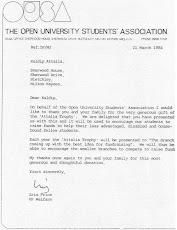
Open University MK